The 'Matchbox' modular factory architecture is a community-developed design philosophy focused on ultra-compact, high-density sub-factories. By enforcing single-resource input boundaries and utilizing vertical gravity chutes instead of serpentine conveyors, players eliminate buffer stalls and easily stamp self-contained production modules across expanding desert worlds.
Design Philosophy
Matchbox Micro-Footprint Architecture
Community Provenance
Sandustry Vault Blueprint #208
Boundary Rule
Single-item dedicated input isolation
Vertical Logistics
Gravity drop chutes over conveyor belts
Blueprint Hotkey
Alt+C / C drag selection for modular stamping
Deadlock Elimination
Zero cross-chute backpressure mixing
Last Checked: 20 September 2026
Community design Vault #208 + Update #4 Pipe Bridge mechanics
Quick answer
How do you build a compact 'Matchbox' modular factory in Sandustry?
A Matchbox factory isolates each production recipe into an ultra-tight, enclosed rectangular module (typically 6x8 to 8x10 tiles). To avoid deadlocks in micro-layouts, feed each module with strictly one item type per input port, drop materials vertically through open gravity chutes rather than looping conveyors, and dock inputs directly to an exterior master bus using Pipe Bridges and Alt+C blueprint stamping.
As factories expand across the desert, sprawling ad-hoc layouts quickly become unmaintainable when terrain obstacles or logistical chokepoints arise. The 'Matchbox' design philosophy resolves this by condensing individual production steps into rigid, standardized rectangular modules (typically 6x8 to 8x10 tiles).
By constraining each module's perimeter, players can cleanly tile production cells alongside primary transport spines. This modular approach keeps spaghetti routing contained within isolated boundaries and ensures any production line can be cloned or decommissioned without breaking neighboring infrastructure.
Advertisement
Matchbox Cell Layout & Compact Machine Spacing
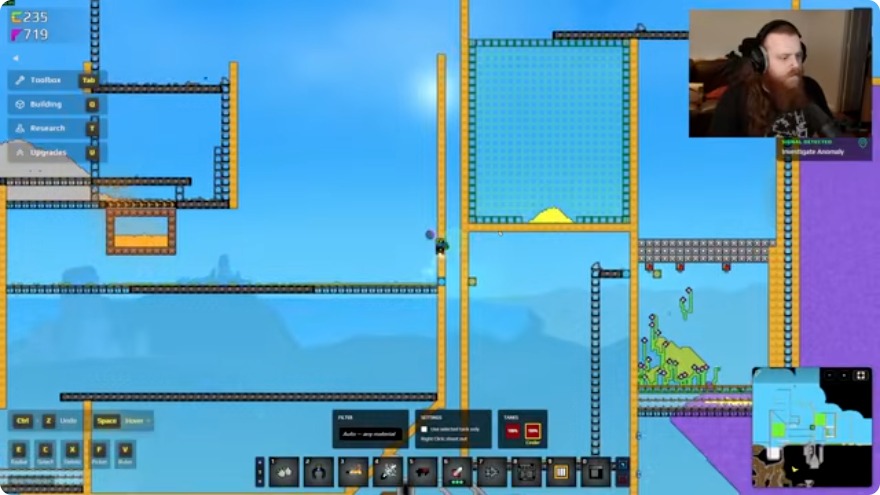
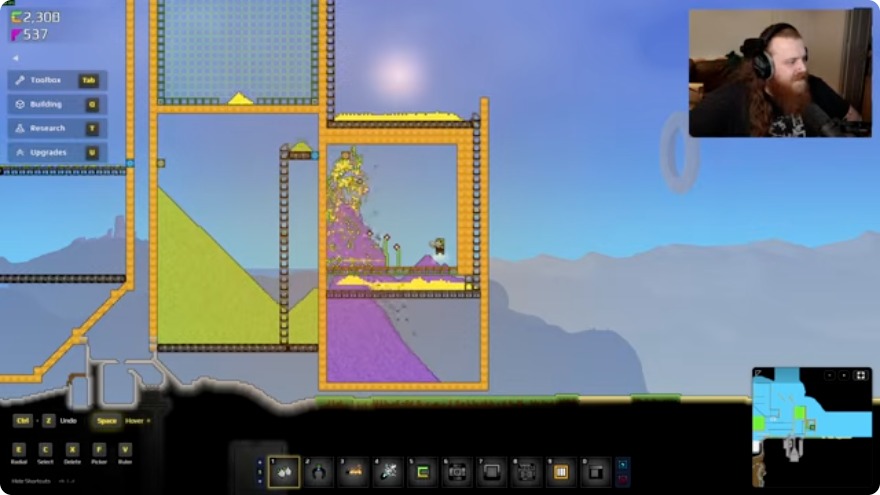
A high-density sub-factory cell showing compact machine alignment and minimal footprint routing.Community-reported @ https://sandustryvault.com/blueprints/208Internal machine positioning maximizing zero-gap clearance between processing units.Community-reported @ https://sandustryvault.com/blueprints/208
02
02 · The Single-Resource Boundary Rule (Anti-Deadlock Isolation)
The cardinal rule of high-density sub-factories is strict input isolation: exactly one resource type per input conveyor or conduit. In large sprawling factories, long conveyors act as unintentional buffers that hide material imbalances; in a compact Matchbox cell with only 2 to 3 tiles of internal conveyor run, there is zero buffer tolerance.
If a belt delivers mixed inputs—such as raw gravel alongside wet sand—any downstream backpressure on the secondary item will immediately block the inlet nozzle. This starves the primary crafter and triggers a permanent factory standstill. Enforcing dedicated single-item delivery lines guarantees uninterrupted continuous operation.
03
03 · Vertical Gravity Drop Injection vs Conveyor Chokes
Conveyor belts require horizontal clearance and consume lateral tiles whenever a turn or elevation change is needed. In Matchbox micro-architecture, vertical gravity chutes take advantage of Sandustry's granular physics to replace horizontal transit.
By stacking processing equipment—such as Shakers, Dryers, and Presses—directly beneath overhead sifting screens, loose pixels fall instantly into machine receiving funnels below. This eliminates conveyor wear, avoids horizontal corner choking, and frees interior tile space for plumbing and power connections.
Gravity Chute Routing & Master Bus Integration
Vertical drop arrangement allowing sifted items to fall directly into intake hoppers without horizontal belts.Community-reported @ https://old.reddit.com/r/SandustryGame/Modular sub-factory integration along the primary logistics spine for modular expansion.Community-reported @ https://old.reddit.com/r/SandustryGame/
04
04 · Master Bus Docking & Blueprint Stamping
Connecting multiple Matchbox modules requires a standardized interface. Align all input ports along the front edge facing a multi-lane master bus, and route finished products through a dedicated rear or subterranean output line.
With Update #4's introduction of Pipe Bridges and non-snapping manual pipes, perpendicular fluid feeds can cross cleanly across the transport spine on a single tile without cross-contamination. Once validated, drag-select the cell using the Blueprint tool (C key / Alt+C) to store the blueprint for instant replication whenever production quotas expand.
Isolate Florin gas vents from condenser liquid intake
Press / Smelting Cell
8x10 tiles
Linear short-throw conveyor push
Single solid ingot stream with dedicated return loop
Steam Power Substation
6x6 tiles
Direct boiler-to-turbine coupling
Depleted exhaust venting to eliminate turbine backpressure
Master Bus Docking Bay
4-tile spine width
Perpendicular crossing bridges
Strict 0-gap parallel fluid piping without auto-snap
Questions answered
Solve the next blockage.
What is the Matchbox factory concept in Sandustry?+
Matchbox is a community-engineered modular design pattern where each sub-assembly (e.g. Florinol condensing, Shaker sifting, or Gold refining) is compacted into a self-contained rectangular cell fed by an external bus.
Why do mixed-item belts cause deadlocks in compact layouts?+
Because compact modules lack storage buffers, any slight imbalance causes unused items to jam the input hopper, blocking subsequent items and permanently halting the entire module.
How does Update #4 improve compact factory building?+
Update #4 introduced Pipe Bridges and non-snapping manual pipe placement, allowing fluid conduits carrying water, lava, or fuels to cross directly over each other without occupying additional tiles.
How did Update #4 affect seed wetting in Matchbox modules?+
Because Update #4 prevents horizontal conveyors from pushing dry seeds into water columns, compact Matchbox designs must route seed wetting through vertical gravity chutes. Dropping seeds into a single-tile water curtain wets them instantly without occupying horizontal footprint or stalling the feed conveyor.
Can Matchbox layouts be saved as Blueprints?+
Yes. You can drag-select the entire perimeter using the Blueprint tool (C key / Alt+C) and save the design to your blueprint library for rapid expansion.
How do vertical chutes handle high throughput compared to conveyors?+
Vertical chutes drop falling physics items instantly via gravity with zero transport delay, whereas horizontal conveyors introduce transit latency and corner-choking risks in tight spaces.
Evidence notes
Confirmed first. Tested second.
Source Wiki
Building over a crossing pipe line creates a Pipe Bridge, allowing perpendicular fluids to pass without mixing (Update #4).
Pipes connect only when deliberately dragged between valid terminal points without auto-snapping (Update #4).
Blueprints capture selected structures, pipe connections, and rotation states for instant modular placement.
Community-tested
Sandustry Vault #208 ('Compact Matchbox factory'): High-density community design establishing 8x8 single-product production modules with integrated gravity feed chutes.
Community-reported @ https://old.reddit.com/r/SandustryGame/comments/1wkiwmg/: LordQuackQuackIII published the final Matchbox design revision with updated color coding, highlighting that Update #4 requires vertical drop chutes rather than horizontal belts for seed-to-water feeding to avoid conveyor deadlocks.
Community Builder Reviews: Proves vertical drop routing prevents the micro-buffer starvation common when players force snake conveyors into tight sub-10-tile enclosures.
These are useful player examples, not official specifications.